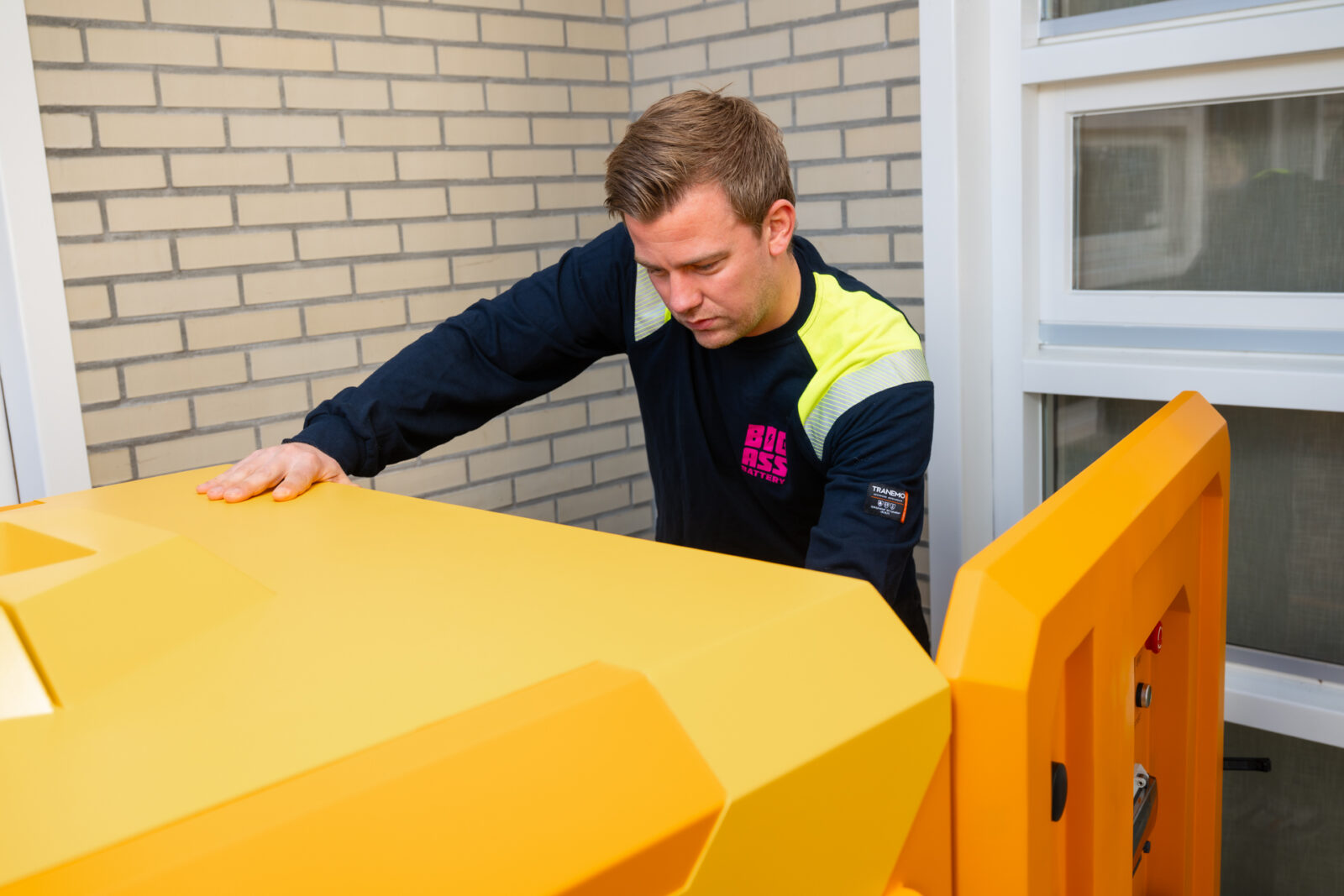
Construction sites are becoming increasingly electrified. Cranes, excavators, charging points and other heavy equipment are running on electricity more often. But the available power capacity does not always keep pace. A temporary grid connection is not available everywhere, or it may not provide enough power. That is where mobile battery storage comes in: bringing electricity to the place where you need it.
Why is power on a construction site not always a given?
Construction sites often require a lot of power, but only for a limited period of time.
In the Netherlands, construction companies and project developers are increasingly unable to obtain a temporary construction connection during the build phase. At other locations, the available connection is too limited to power electric cranes, excavators or charging infrastructure at the same time.
A diesel generator may seem like the obvious solution, but that option is also facing more restrictions. Municipalities and clients are setting stricter requirements for CO₂ emissions, noise and local air quality. In urban environments, nature areas or indoor locations, a generator is simply not always the right solution.
A mobile battery provides a practical alternative: charge it where energy is available and bring that energy to the construction site.
What is battery storage on a construction site?
In practice, a mobile battery works like a large, portable power bank. It stores electricity and supplies it later on the construction site to machines, charging points or temporary installations. Depending on the configuration, the battery can be charged via:
- A fixed grid connection
- Solar panels
- A generator
- Another available energy source
On the construction site, stored energy can be used to charge electric machines or provide temporary extra power. No grid connection? No problem. Energy comes to you.
When is a mobile battery a good option?
Battery storage on a construction site is particularly relevant when several of the following situations apply:
- No temporary construction connection is available.
- The available grid connection does not provide enough power.
- Electric cranes, excavators, or other equipment need to be charged.
- The construction site must operate emission-free or with low CO₂ emissions.
- A diesel generator is not permitted or is undesirable.
- Noise, odour or local emissions are an issue.
- Machines and activities move regularly.
- Low-emission operation provides an advantage in tenders.
A mobile battery is therefore not just an emergency solution. It can also be a strategic choice that allows you to work more flexibly and strengthen your position in tenders.
Battery or diesel generator: what is the difference?
Both systems can provide power where the grid is unavailable or insufficient. But they differ significantly in day-to-day use.
Battery storage
A battery produces no local exhaust emissions during use and is much quieter than a diesel generator.
That makes mobile battery storage attractive for:
- Urban construction sites
- Indoor spaces and industrial buildings
- Demolition projects
- Nature areas
- Locations with strict noise or emission limits
The battery can charge electric equipment, supply temporary installations, or absorb power peaks when the available grid connection is insufficient.
Diesel generator
A generator can continue to deliver power as long as fuel is available. That means it can still be useful in some situations as a back-up or additional energy source.
The downside is noise, odour, fuel costs and CO₂ emissions. In addition, clients and local authorities are increasingly placing restrictions on their use.
The choice does not always have to be a battery or generator. In a hybrid setup, the battery can handle daily demand while the generator only steps in when it is really needed. This reduces fuel consumption, noise and emissions.
The benefits go beyond compliance
Working emission-free or with low emissions is an important reason to choose battery storage. But there are also practical benefits on the construction site itself.
A mobile battery reduces noise nuisance for local residents and employees. There is no diesel smell and no local exhaust emissions during use.
That makes the working environment more comfortable, especially indoors, in densely built-up areas or on projects where people work close to the installation.
The energy also moves with the construction site. If the project relocates, the battery moves with it. You are not tied to one fixed connection and can use the power exactly where it is needed.
Not every battery suits every construction site
Looking only at storage capacity in kWh is not enough. Power output in kW is at least as important. A battery may contain enough energy but still be unable to provide the power required to start heavy equipment or charge several vehicles at the same time.
That is why you should map out the following in advance:
- Which machines need to run or charge?
- How much power do they require?
- How long are they used?
- When do the highest power peaks occur?
- Where and when can the battery be recharged?
- Should the battery operate independently or together with the grid, solar panels or a generator?
- How will the battery be transported between locations?
The right solution does not start with the largest battery, but with the actual energy profile of the construction site.
Need mobile power on your construction site?
Map out your machines, power peaks, and charging options. With an Energy Scan, we determine which mobile battery best fits your project.